
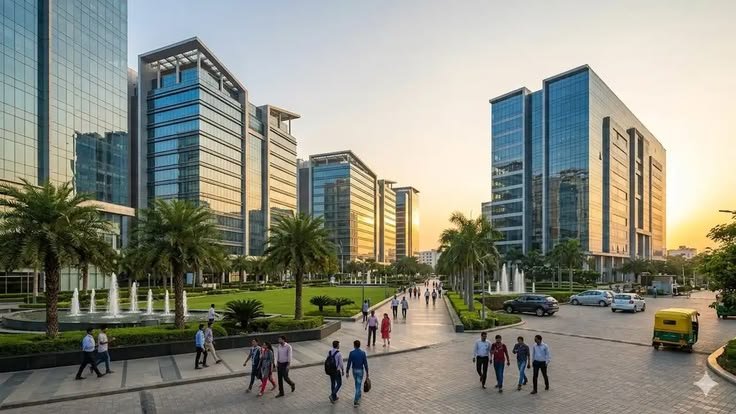
For years, choosing where to live in Hyderabad came down to one question: how close can I get to my office?
It made sense. HITEC City, Gachibowli and the Financial District weren’t just workplaces, they were the reason lakhs of professionals moved to the city in the first place. So homebuyers followed the jobs. Proximity to the office became the single biggest factor in the decision, sometimes the only factor that mattered.
That equation is quietly changing.
Walk through any of Hyderabad’s western residential pockets today, and the conversation among homebuyers sounds different. It’s no longer just “how far is my commute.” It’s “what does my life look like once I get home.” Families are asking about parks, not just parking. About schools within reach, not just how many minutes to the office park. About whether a neighbourhood feels like somewhere to build a life, not just somewhere to sleep between workdays.
This is the story of how Hyderabad’s IT corridors matured from employment zones into something families are choosing to actually live in, and what that shift means for anyone house-hunting near the city’s tech hubs today.
The Old Formula: Live Close, Commute Less
To understand how far things have moved, it helps to remember where they started.
When HITEC City and the surrounding IT corridor began attracting large-scale employment, Hyderabad’s residential development followed a fairly predictable logic. Homes came up wherever jobs were, often quickly, often with commute time as the primary selling point. Social infrastructure, schools, hospitals, markets, recreational spaces, tended to arrive later, playing catch-up to the residential towers that had already gone up.
This worked reasonably well when the priority was singular: reduce the daily grind of getting to work. But it also meant that a lot of early development in these corridors was optimised for proximity first and everything else second.
As these areas matured and filled in, that gap started to close. And as it closed, buyer expectations started to shift right along with it.
When an IT Corridor Grows Up
An IT corridor doesn’t stay just an IT corridor forever, not if it’s successful.
Give any employment hub enough years, and something predictable happens. Restaurants move in because there are people to feed. Hospitals expand because there are families to care for. Schools open because employees start having children and don’t want a long commute for their kids either. Malls, gyms, parks and entertainment options follow the same logic, they show up because the demand is already there.
This is exactly what’s played out across Hyderabad’s western corridor. Areas that were once defined purely by office parks and tech campuses have slowly built out the social infrastructure that makes a place genuinely liveable, not just employable.
And once that infrastructure exists, something interesting happens to buyer psychology. The IT corridor stops being viewed only through the lens of “where I work” and starts being evaluated as “where I could actually live, raise a family, and build a life around.”
That’s the real shift. Not that people have stopped caring about commute, but that commute has stopped being the only thing they care about.

What Families Are Actually Weighing Now
Talk to homebuyers actively searching near Hyderabad’s IT hubs today, and a fairly consistent list of priorities comes up, well beyond distance to office.
Schools and childcare access. For families with young children, or planning to have them, the quality and proximity of good schools has become a decision-making factor almost as important as the commute itself.
Healthcare within reach. Proximity to reliable hospitals and clinics matters more than it used to, especially for families with elderly parents living with them.
Everyday convenience. Grocery stores, pharmacies, cafes and basic services within a short distance change the day-to-day experience of living somewhere far more than most buyers expect going in.
Green and recreational spaces. As IT corridors get denser, access to parks, walking tracks and open spaces has become a genuine differentiator, not a nice-to-have.
Community feel. This one is harder to quantify, but buyers consistently mention wanting a neighbourhood that feels lived-in, not just a cluster of towers with no connective tissue between them.
Long-term liveability. Families increasingly think five and ten years ahead, will this area still work when children are older, when parents need to be closer, when the household’s needs change.
It’s worth noting how closely this list maps onto what’s actually coming up in Kondapur right now. Namishree Vrindavan, for instance, sits a short walk from CHIREC School on Road 4, so the schools box gets ticked before a family even starts touring apartments. A dedicated senior citizens’ plaza and a temple on-site speak to the “parents need to be closer” concern directly. Jogging and cycling tracks, a gym and a yoga and meditation area cover the green-space and wellness end of the list. And a clubhouse, community hall, library and amphitheater spread across roughly 9.5 acres are less about amenities on a brochure and more about giving 1,846 households across 8 towers somewhere to actually run into each other.
Commute obviously still matters. Nobody’s signing up for a two-hour drive each way. But it’s no longer carrying the entire decision on its own. It’s one strong factor among several, not the only one that counts.
The Corridors Reshaping Hyderabad’s Residential Map
Hyderabad’s western stretch remains the heart of this story, but different pockets within it are answering the “live, not just work” question in different ways.
Gachibowli and HITEC City continue to anchor the region, with the deepest concentration of established social infrastructure built up over years of sustained residential and commercial growth. Kondapur has matured into one of the city’s steadiest residential markets, valued for the balance it strikes between connectivity to the IT corridor and genuinely developed neighbourhood life, schools, hospitals and everyday convenience all well within reach. Newer gated developments coming up in the area are a fairly clear sign of where buyer expectations in this pocket have settled. Namishree Vrindavan, spread across roughly 9.5 acres with 8 towers rising to 49 floors, is a useful example, a RERA-registered, high-rise gated community offering 2, 3 and 4 BHK homes from about 1,475 to 3,375 sq ft, built with a clubhouse, jogging tracks and dedicated spaces for children and senior citizens folded into the same address as the daily commute.
Further along, the Financial District and Nanakramguda have grown rapidly as corporate campuses expanded westward, pulling residential development along with them. And newer, more ground-up planned developments closer to Kokapet and the western ORR stretch are attempting something slightly different, building the social infrastructure and the residential towers together from the start, rather than having one chase the other.
Each of these pockets is really answering the same underlying question in its own way: how do you live well, not just work nearby.
Best Residential Areas Near IT Hubs in Hyderabad
For homebuyers narrowing down where to actually settle near Hyderabad’s tech corridors, a few areas consistently come up as strong contenders, each suited to slightly different priorities.
For buyers who want established infrastructure and don’t want to wait for a neighbourhood to develop, Kondapur and Gachibowli remain difficult to beat, mature social ecosystems, strong resale markets and proven connectivity to the major IT campuses. Large-format gated communities like Namishree Vrindavan, near CHIREC School on Road 4, add to that pull, close to 1,846 units across 8 towers, with everyday conveniences and lifestyle amenities built into the same footprint as the commute.
For those prioritising proximity to corporate headquarters in the newer business districts, the Financial District and Nanakramguda offer a shorter commute to some of the city’s newest and largest office developments, with residential and lifestyle infrastructure steadily catching up.
For buyers thinking in terms of long-term appreciation and a more planned, ground-up living experience, areas around Kokapet and the western ORR corridor are worth watching closely, still earlier in their growth curve, but built with the live-work-play balance in mind from the outset.
And for families who want IT-corridor connectivity without the density and pricing of the most established micro-markets, some of the developing pockets just beyond the core corridor are increasingly worth a serious look, offering more breathing room, often better value, and infrastructure that’s catching up quickly.
The right answer isn’t universal. It depends on whether a buyer is optimising for today’s convenience or tomorrow’s growth, and that’s a genuinely personal call.

Why Community Is Becoming the New Commute
Perhaps the most telling shift in all of this is a change in language. Ask homebuyers near Hyderabad’s IT corridors what they’re looking for today, and “community” comes up almost as often as “commute” does.
This isn’t a coincidence. It reflects a broader realisation that a home isn’t just a place to sleep between office hours, it’s the environment where daily life actually happens. Evening walks, weekend errands, children playing outdoors, neighbours who become familiar faces, these are the things that determine whether a place feels like home or just an address close to work.
Developers who’ve picked up on this are increasingly designing projects around that reality, building in landscaped open spaces, walking tracks, community areas and access to nearby amenities, rather than treating the residential tower as an isolated unit dropped near an office park. A clubhouse, community hall, library and amphitheater within the same gated layout, the kind Namishree Vrindavan in Kondapur has built in, are less about ticking amenity boxes and more about giving residents actual reasons to step outside their own front door.
The corridors that get this balance right, connectivity to work paired with genuine everyday liveability, are the ones proving most resilient to shifting buyer preferences.
The Future of Living Near Work
Hyderabad’s IT corridors aren’t going to stop being employment hubs anytime soon. If anything, continued growth across technology, GCCs and allied sectors means these areas will keep drawing people who want to be close to where the jobs are.
But the definition of “close to work” is expanding. It increasingly means close to good schools too. Close to reliable healthcare. Close to a park worth walking in. Close to a community that feels like more than just a collection of neighbours who happen to share a commute.
For homebuyers evaluating where to settle near Hyderabad’s tech hubs, that’s genuinely good news. The choice is no longer between a short commute and a full life. Increasingly, especially in the corridors that have matured or been planned with intention from the start, it’s possible to have both.